Your movie nominees for the May screening will be:
Eraserhead (dir: David Lynch)
Night on Earth (dir: Jim Jarmusch)
The Seventh Seal (dir: Ingmar Bergman)
The Conversation (dir: Francis Ford Copolla)
The Killing (dir: Stanley Kubrick)
To place your vote, leave a comment on this post, vote in the poll on the right hand side of the page, send us an e-mail, or show up to the Movie Geeks Club screening of The Pianist on April 29.
Wednesday, March 26, 2008


April Movie: The Pianist
On April 29 the Movie Geeks Club will screen the Roman Polanski World War II memoir adaptation The Pianist. As always, the doors will open at 7:00, and the movie will start at 7:30.
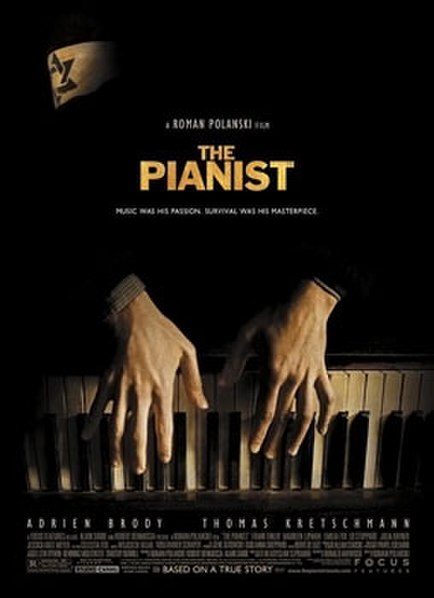 The Pianist won the Palme d'Or at the Cannes Film Festival as well as the Oscars for Best Director, Best Actor, and Best Adapted Screenplay.
This is actually a film I've never seen, so I'm excited to check it off my list.
The Pianist won the Palme d'Or at the Cannes Film Festival as well as the Oscars for Best Director, Best Actor, and Best Adapted Screenplay.This is actually a film I've never seen, so I'm excited to check it off my list.
Monday, March 24, 2008
Dan Schneider on Aguirre: The Wrath Of God
Dan Schneider on Aguirre: The Wrath Of God: "DVD Review Of Aguirre: The Wrath Of God"
 Werner Herzog may just be the best film director of the last forty years. Period. And I mean worldwide. While some directors of film rely primarily on precision-think Alfred Hitchcock, intellect- think Ingmar Bergman and Stanley Kubrick, visual poesy-think Terrence Malick, or visceral reaction- think Akira Kurosawa, there is no other major filmmaker that I can think of who combines all of these things so skillfully, as well as having a mastery of music, outside of Herzog. From musical scoring to narrative pacing to visual imagery, he reigns supreme. Before watching his 1972 masterpiece, Aguirre: The Wrath Of God (Aguirre, Der Zorn Gottes), for the first time, all I had seen of Herzog were some of his documentary style films and Fitzcarraldo. This was enough to intrigue me to explore his corpus more fully, and I’m glad I did, for there’s a reason this film made him a ‘name’ on par with his contemporary German directors, Rainer Werner Fassbinder and Wim Wenders.
Aguirre: The Wrath Of God is a film that combines the best elements of such diverse great films as Alien, 2001: A Space Odyssey, and Apocalypse Now, although it is a much more visceral work than any of those films, and is topped off by one of the truly great screen performances of all time, with Klaus Kinski as the titular lead, Don Lope de Aguirre, a cripple who may also be a hunchback- whose outer deformities seem to have scarred him internally, as well. While there are numerous other supporting characters that turn in fine performances, Kinski utterly dominates the screen every second he’s on it, moving like some perverse and slavering arachnid, moving in for the kill of an insect he will never bleed fully for he will never truly get it.
The making of this film has become as legendary as Coppola’s own odyssey in bringing the similarly themed Apocalypse Now to the screen. Aguirre was shot on a low budget of less than $400,000, in about a month in 1971, with a 35mm camera Herzog admits he stole, but it was his fighting with Kinski on the set, and the legend of Herzog’s pulling a gun on the actor, to keep him in line, that helped contribute to its worldwide success. Herzog reputedly wrote the screenplay in two and a half days, if his informative and thankfully fellatio-free DVD commentary with Norman Hill is to be believed, but Herzog is a known embellisher. Likewise, although he has long claimed that the film was based upon the real story of the real Aguirre, a Conquistadore, Herzog admits on the commentary track that the bulk of the film is fictive, with only a few historical details peppered within.
[spoilers excerpted]
While the film may seem slow going at first, especially in the twenty or so minutes after the haunting visual descent from the Andes that opens the film, there is simply no way to not be swept up in the grandeur of this film, for it was shot with just one camera, and in such close quarters, that when I have read this film described as ‘epic’ I know that the critic is merely tossing about a word that will catch someone’s attention. Lawrence Of Arabia is epic, but this film is a highly personalized portrait of one man, in both its acting style and shooting style, that relentlessly circles its lead until we stare full bore into the maw of megalomania. Aguirre himself, seems to look directly into the camera as he declares, late in the film, ‘If I, Aguirre, want the birds to drop dead from the trees, then the birds will drop dead from the trees. I am the wrath of God!’ Such a head on glare into insanity gets a viewer almost emotionally claustrophobic by film’s end, which is the exact antithesis of the definition of ‘epic’. And, unlike 2001: A Space Odyssey, which ends in transcendence, Aguirre merely ends, before the cusp. And, at only 94 minutes in length, it seems much longer- but in the best and grandest sense, whereas 2001: A Space Odyssey and Apocalypse Now are much longer films, if no more effective thematically and poetically.
Other than the DVD commentary, which with Herzog is always a treat, philosophically and in terms of the film’s making, the DVD transfer by Anchor Bay is sterling, and because it is a period piece, it has not aged one bit in terms of look. It is as vibrant as a recent film, with great tone and an excellent soundtrack by Florian Fricke’s German band Popol Vuh (after the Mayan creation myth), which always is a Herzog strength. They used electronic equipment to generate the almost human sounding choral hymns, which are hauntingly sad without being mawkish, nor bathetic. Yes, the film is slightly cropped for a television screen, at a 1.33:1 ratio, but that’s a minor quibble given the fact the film was originally shot in a almost identical 1.37:1 ratio, meaning Herzog never intended the film to be in widescreen format, some seemingly divine ratio only American films seem to obsess over. What is really terrific is that the film is expertly dubbed into English- in fact, it was actually filmed in English first, so that there is no noxious reading of subtitles necessary for the wise viewer who wants to avoid eyestrain. This means one can enjoy the film in one viewing, and even those people who hate dubbing cannot complain because the dub is as flawless as I’ve ever seen in regards to lip synchronization. There are also three trailers for the film included.
Many critics often opt out of a real discussion of Herzog’s excellence in craft by falling back on the old and misguided notion that he simplistically follows his whims and is guided by the same sort of madness he accuses Kinski of always fostering. Yet, any look at a film like this shows that Herzog transcends such myopic claims, even if unwittingly; although I seriously doubt the man who is such a scrupulous artist has ever let a foot of film be released under his name without a bit of wit applied to it. As for the screenplay? It is brilliant, knowing when to let the characters speak, and what they should say, and also relying on chance events, such as a flood which washed away Herzog’s rafts. He incorporated that misfortune into the tale. Yet, what the film ultimately says means less than the whole experience, or how it is said through the art. Herzog’s small budget becomes a strength when he cannot do overhead shots from a plane, or elaborate crane shots, nor delving close ups that gradually close in on someone, nor elaborate retakes, as Herzog, in the commentary, admits that one take was the rule- although out of practical necessity, rather than the odd obsessiveness of a Fassbinder. The camera, helmed by cinematographer Thomas Mauch, is always with the Spaniards, not beyond them, and by the film’s end the apparent motion of the raft is circular, with shots showing it move from left to right, then right to left, onscreen, whereas earlier the movement of the film and the characters was always straight ahead, almost at the viewer. The final shots, with the deluded madman Aguirre in full rant, has Herzog in a speedboat, circling around, adding final anomy to the motion of the story, and possibly history. Yet, there are other bravura celluloid moments, such as the aforementioned leaving of the horse, an early shot of the ferocious and turbid brown rapids that Herzog holds on long enough to unsettle a viewer, raindrops being left on the camera lens during a drizzle on the river, and an eerie close up of an Indian flutist, whom Herzog says, on the commentary, was retarded.
Yet, Herzog admits with justified pride that this film succeeds precisely because it does not follow the Hollywood formula: there is no real hero to root for, no predictable victory to cheer for, no visible bad guys, and no romantic interest for the leading character.
[spoilers excerpted]
Aguirre: The Wrath Of God is an indisputable masterpiece, and one of the greatest films not only of German cinema, but human cinema. That Herzog directed it when he was only twenty-eight years old is astonishing. Its combination of improvisation- for Herzog loathes storyboards, calling them the ‘disease of Hollywood’, with an almost Bergmanian chamber drama focus on an individual, also makes it one of the most unique films ever crafted. It is a film to be seen by anyone with a love of art, intellect, and human nature, at any age, and in any age.
Werner Herzog may just be the best film director of the last forty years. Period. And I mean worldwide. While some directors of film rely primarily on precision-think Alfred Hitchcock, intellect- think Ingmar Bergman and Stanley Kubrick, visual poesy-think Terrence Malick, or visceral reaction- think Akira Kurosawa, there is no other major filmmaker that I can think of who combines all of these things so skillfully, as well as having a mastery of music, outside of Herzog. From musical scoring to narrative pacing to visual imagery, he reigns supreme. Before watching his 1972 masterpiece, Aguirre: The Wrath Of God (Aguirre, Der Zorn Gottes), for the first time, all I had seen of Herzog were some of his documentary style films and Fitzcarraldo. This was enough to intrigue me to explore his corpus more fully, and I’m glad I did, for there’s a reason this film made him a ‘name’ on par with his contemporary German directors, Rainer Werner Fassbinder and Wim Wenders.Aguirre: The Wrath Of God is a film that combines the best elements of such diverse great films as Alien, 2001: A Space Odyssey, and Apocalypse Now, although it is a much more visceral work than any of those films, and is topped off by one of the truly great screen performances of all time, with Klaus Kinski as the titular lead, Don Lope de Aguirre, a cripple who may also be a hunchback- whose outer deformities seem to have scarred him internally, as well. While there are numerous other supporting characters that turn in fine performances, Kinski utterly dominates the screen every second he’s on it, moving like some perverse and slavering arachnid, moving in for the kill of an insect he will never bleed fully for he will never truly get it.
The making of this film has become as legendary as Coppola’s own odyssey in bringing the similarly themed Apocalypse Now to the screen. Aguirre was shot on a low budget of less than $400,000, in about a month in 1971, with a 35mm camera Herzog admits he stole, but it was his fighting with Kinski on the set, and the legend of Herzog’s pulling a gun on the actor, to keep him in line, that helped contribute to its worldwide success. Herzog reputedly wrote the screenplay in two and a half days, if his informative and thankfully fellatio-free DVD commentary with Norman Hill is to be believed, but Herzog is a known embellisher. Likewise, although he has long claimed that the film was based upon the real story of the real Aguirre, a Conquistadore, Herzog admits on the commentary track that the bulk of the film is fictive, with only a few historical details peppered within.
[spoilers excerpted]
While the film may seem slow going at first, especially in the twenty or so minutes after the haunting visual descent from the Andes that opens the film, there is simply no way to not be swept up in the grandeur of this film, for it was shot with just one camera, and in such close quarters, that when I have read this film described as ‘epic’ I know that the critic is merely tossing about a word that will catch someone’s attention. Lawrence Of Arabia is epic, but this film is a highly personalized portrait of one man, in both its acting style and shooting style, that relentlessly circles its lead until we stare full bore into the maw of megalomania. Aguirre himself, seems to look directly into the camera as he declares, late in the film, ‘If I, Aguirre, want the birds to drop dead from the trees, then the birds will drop dead from the trees. I am the wrath of God!’ Such a head on glare into insanity gets a viewer almost emotionally claustrophobic by film’s end, which is the exact antithesis of the definition of ‘epic’. And, unlike 2001: A Space Odyssey, which ends in transcendence, Aguirre merely ends, before the cusp. And, at only 94 minutes in length, it seems much longer- but in the best and grandest sense, whereas 2001: A Space Odyssey and Apocalypse Now are much longer films, if no more effective thematically and poetically.
Other than the DVD commentary, which with Herzog is always a treat, philosophically and in terms of the film’s making, the DVD transfer by Anchor Bay is sterling, and because it is a period piece, it has not aged one bit in terms of look. It is as vibrant as a recent film, with great tone and an excellent soundtrack by Florian Fricke’s German band Popol Vuh (after the Mayan creation myth), which always is a Herzog strength. They used electronic equipment to generate the almost human sounding choral hymns, which are hauntingly sad without being mawkish, nor bathetic. Yes, the film is slightly cropped for a television screen, at a 1.33:1 ratio, but that’s a minor quibble given the fact the film was originally shot in a almost identical 1.37:1 ratio, meaning Herzog never intended the film to be in widescreen format, some seemingly divine ratio only American films seem to obsess over. What is really terrific is that the film is expertly dubbed into English- in fact, it was actually filmed in English first, so that there is no noxious reading of subtitles necessary for the wise viewer who wants to avoid eyestrain. This means one can enjoy the film in one viewing, and even those people who hate dubbing cannot complain because the dub is as flawless as I’ve ever seen in regards to lip synchronization. There are also three trailers for the film included.
Many critics often opt out of a real discussion of Herzog’s excellence in craft by falling back on the old and misguided notion that he simplistically follows his whims and is guided by the same sort of madness he accuses Kinski of always fostering. Yet, any look at a film like this shows that Herzog transcends such myopic claims, even if unwittingly; although I seriously doubt the man who is such a scrupulous artist has ever let a foot of film be released under his name without a bit of wit applied to it. As for the screenplay? It is brilliant, knowing when to let the characters speak, and what they should say, and also relying on chance events, such as a flood which washed away Herzog’s rafts. He incorporated that misfortune into the tale. Yet, what the film ultimately says means less than the whole experience, or how it is said through the art. Herzog’s small budget becomes a strength when he cannot do overhead shots from a plane, or elaborate crane shots, nor delving close ups that gradually close in on someone, nor elaborate retakes, as Herzog, in the commentary, admits that one take was the rule- although out of practical necessity, rather than the odd obsessiveness of a Fassbinder. The camera, helmed by cinematographer Thomas Mauch, is always with the Spaniards, not beyond them, and by the film’s end the apparent motion of the raft is circular, with shots showing it move from left to right, then right to left, onscreen, whereas earlier the movement of the film and the characters was always straight ahead, almost at the viewer. The final shots, with the deluded madman Aguirre in full rant, has Herzog in a speedboat, circling around, adding final anomy to the motion of the story, and possibly history. Yet, there are other bravura celluloid moments, such as the aforementioned leaving of the horse, an early shot of the ferocious and turbid brown rapids that Herzog holds on long enough to unsettle a viewer, raindrops being left on the camera lens during a drizzle on the river, and an eerie close up of an Indian flutist, whom Herzog says, on the commentary, was retarded.
Yet, Herzog admits with justified pride that this film succeeds precisely because it does not follow the Hollywood formula: there is no real hero to root for, no predictable victory to cheer for, no visible bad guys, and no romantic interest for the leading character.
[spoilers excerpted]
Aguirre: The Wrath Of God is an indisputable masterpiece, and one of the greatest films not only of German cinema, but human cinema. That Herzog directed it when he was only twenty-eight years old is astonishing. Its combination of improvisation- for Herzog loathes storyboards, calling them the ‘disease of Hollywood’, with an almost Bergmanian chamber drama focus on an individual, also makes it one of the most unique films ever crafted. It is a film to be seen by anyone with a love of art, intellect, and human nature, at any age, and in any age.
Sunday, March 23, 2008
All Systems Go!
We are full steam ahead for Aguirre, the Wrath of God on Tuesday night. Thanks to Russ, one of our oldest and most loyal movie geeks, we will have a copy for the screening.
Capital City Bar and Grill
Doors open at 7:00 PM. Film starts at 7:30 PM.
As always, there is no cover charge or admission fee.
Capital City Bar and Grill
Doors open at 7:00 PM. Film starts at 7:30 PM.
As always, there is no cover charge or admission fee.
Friday, March 21, 2008
Interesting Facts about Aguirre, the Wrath of God
- In order to get the performance he desired, before each shot Herzog would deliberately infuriate Kinski. After waiting for the hot-tempered actor's inevitable tantrum to "burn itself out", Herzog would then roll the camera.
- The camera used to shoot the film was stolen by Herzog from the Munich Film School.
- The low budget precluded the use of stunt men or elaborate special effects. The cast and crew climbed up mountains, hacked through thick jungle, and rode ferocious Amazonian river rapids on rafts built by natives. At one point, a storm caused a river to flood, burying the film sets underneath several feet of water and destroying all of the rafts built for the film. This flooding was immediately incorporated into the story, as a sequence including a flood and subsequent rebuilding of rafts was shot.
- The soundtrack was composed and performed by German progressive/Krautrock band Popol Vuh.
- Near the end of the shooting, Werner Herzog thought he had lost all the negatives that the film was shot on. He later discovered that the shipping agency at the Lima airport had completed all paperwork that accompanied the transportation of the film cans, but had not actually shipped them. The cans were thought lost for several weeks before the oversight was revealed.
- To obtain the monkeys utilized in the climactic sequence, Herzog paid several locals to trap 400 monkeys; he paid them half in advance and was to pay the other half upon receipt. The trappers sold the monkeys to someone in Los Angeles or Miami, and Herzog came to the airport just as the monkeys were being loaded to be shipped out of the country. He pretended to be a veterinarian and claimed that the monkeys needed vaccinations before leaving the country. Abashedly, the handlers unloaded the monkeys, and Herzog loaded them into his jeep and drove away, used them in the shot they were required for, and released them afterwards into the jungle.
- Many of the scenes depicted in the film were unrehearsed and unstaged, and the dividing line between the cast acting in character and simply reacting to their situations as people became very blurry. For example, in one of the opening scenes, when the carriage holding Aguirre's daughter tips over and threatens to collapse, a hand comes in from the right side of the frame to assist the actors in steadying their hold. That hand belongs to director Werner Herzog.
- Aguirre was shot in five weeks, following nine months' worth of pre-production planning. The film was shot in chronological order, as Herzog believed the film crew's progress on the river directly mirrored that of the explorers' journey in the story.
- Herzog wrote the screenplay “in a frenzy”, which he completed in only two and a half days. Much of the script was written during a 200-mile (320 km) bus trip with Herzog’s football team. During the bus trip, his teammates got drunk after winning a game and one of them subsequently vomited on several pages of Herzog's manuscript, which he immediately tossed out the window. Herzog claims he can't remember what he wrote on these pages.
- On one occasion, irritated by the noise from a hut where cast and crew were playing cards, the explosive Kinski fired three shots at it, blowing the top joint off one extra's finger. Subsequently, Kinski started leaving the jungle location (over Herzog's refusal to fire a sound assistant), only changing his mind after Herzog threatened to shoot first Kinski and then himself. The latter incident has given rise to the legend that Herzog made Kinski act for him at gunpoint. However, Herzog has repeatedly debunked the claim during interviews, explaining he only verbally threatened Kinski in the heat of the moment, in a desperate attempt to keep him from leaving the set.
- Francis Ford Coppola's 1979 film Apocalypse Now, a movie based on Joseph Conrad's 1902 novella Heart of Darkness, was influenced also by Aguirre, as it contains seemingly deliberate visual "quotations" of Herzog's film. Coppola himself has noted, "Aguirre, with its incredible imagery, was a very strong influence. I'd be remiss if I didn't mention it."
Thursday, March 20, 2008
Problem with Aguirre, The Wrath of God
Here's the problem with Aguirre, the Wrath of God (or any other Werner Herzog movie outside of Grizzly Man or Rescue Dawn): it's nearly impossible to get your hands on a copy here in Springpatch.
Knowing that a problem might ensue with securing this film for our screening, I ordered a copy from Amazon. Then I was notified that there might be a delay in shipping which would mean the film would not arrive in time for our March 25 screening. I had a backup plan, however. Lincoln Library has the only lending copy of the movie in town. I've checked it out before, and I was more than prepared to check it out again. When I went to check it out, however, I found that it had already been checked out. Until the 24th. I've placed a hold on this copy, and if it is returned on time, we will not have an issue. I'll pick it up on the 25th and all will be well for Movie Geeks Club.
If, however, I cannot secure a copy of the film, I have a couple of scenarios for you. Here they are:
1) We watch the Errol Morris documentary Gates of Heaven. I thought this was a reasonable replacement for three reasons. First, I already have a copy of this film in my possession. Second, this movie is the reason that Werner Herzog had to eat his shoe, which was captured in the short film Werner Herzog Eats His Shoe. Third, many critics, including Roger Ebert, consider Gates of Heaven one of the top ten movies of all time. If we go this route, we will screen Aguirre, the Wrath of God in April and move everything else back one month.
2) We flash forward a month and screen Roman Polanski's The Pianist. This movie is running away with the online vote, and I'm certain it will be our nominee for the April movie. If we screen this movie in March, then we will screen Aguirre, the Wrath of God in April. The old switcheroo, see?
3) We screen the much more mainstream (and not as interesting) Werner Herzog feature film Rescue Dawn, starring Christian Bale. This film, based on Herzog's 1997 documentary Little Dieter Needs to Fly, is about German-born Vietnam Veteran Dieter Dengler. This is a totally sweet movie, by most standards, but I feel like it lacks some of the oomph that most of Herzog's features exude. Regardless, it would be a Herzog substitute, and one that we could get our hands on readily. If we go this route, we may want to forgo Aguirre, the Wrath of God until a later date, as I think it is in bad principle to show films by the same director in back-to-back months.
What do you think, Movie Geeks? Let us know via e-mail or in a comment on this blog.
Thanks,
John
Knowing that a problem might ensue with securing this film for our screening, I ordered a copy from Amazon. Then I was notified that there might be a delay in shipping which would mean the film would not arrive in time for our March 25 screening. I had a backup plan, however. Lincoln Library has the only lending copy of the movie in town. I've checked it out before, and I was more than prepared to check it out again. When I went to check it out, however, I found that it had already been checked out. Until the 24th. I've placed a hold on this copy, and if it is returned on time, we will not have an issue. I'll pick it up on the 25th and all will be well for Movie Geeks Club.
If, however, I cannot secure a copy of the film, I have a couple of scenarios for you. Here they are:
1) We watch the Errol Morris documentary Gates of Heaven. I thought this was a reasonable replacement for three reasons. First, I already have a copy of this film in my possession. Second, this movie is the reason that Werner Herzog had to eat his shoe, which was captured in the short film Werner Herzog Eats His Shoe. Third, many critics, including Roger Ebert, consider Gates of Heaven one of the top ten movies of all time. If we go this route, we will screen Aguirre, the Wrath of God in April and move everything else back one month.
2) We flash forward a month and screen Roman Polanski's The Pianist. This movie is running away with the online vote, and I'm certain it will be our nominee for the April movie. If we screen this movie in March, then we will screen Aguirre, the Wrath of God in April. The old switcheroo, see?
3) We screen the much more mainstream (and not as interesting) Werner Herzog feature film Rescue Dawn, starring Christian Bale. This film, based on Herzog's 1997 documentary Little Dieter Needs to Fly, is about German-born Vietnam Veteran Dieter Dengler. This is a totally sweet movie, by most standards, but I feel like it lacks some of the oomph that most of Herzog's features exude. Regardless, it would be a Herzog substitute, and one that we could get our hands on readily. If we go this route, we may want to forgo Aguirre, the Wrath of God until a later date, as I think it is in bad principle to show films by the same director in back-to-back months.
What do you think, Movie Geeks? Let us know via e-mail or in a comment on this blog.
Thanks,
John
Monday, March 17, 2008
Revered Movie Remakes
MSN Movies - Hollywood Hitlist: "In scarier news, Variety reported this week that Michael Bay and his Platinum Dunes production arm are working on a modern version of the classic 'Rosemary's Baby' for Paramount Pictures. It's become acceptable in Hollywood that no matter how revered a movie is, it's a candidate to be remade. This is one that clearly shouldn't be. Screened today, director Roman Polanski's 'Baby' is just as scary as any modern flick. Plus, how any filmmaker could match the original's intensity is hard to imagine, and a quality director wouldn't go near a project like this with a 10-foot pole after the public whipping Gus Van Sant got for remaking 'Psycho' a decade ago."
Subscribe to:
Posts (Atom)